
Japan Platform, Japan
Successes and highlights
Actualising the platform system of bringing different partners together for aid delivery
JPF’s platform system of connecting the major partners in humanitarian aid was a success in and of itself as this did not exist in Japan prior to JPF’s founding. JPF was intended as a new system of emergency humanitarian aid where aid can be delivered in a comprehensive Japanese package, and from the very beginning it brought together the business community (KEIDANREN-Japan Business Federation), Ministry of Foreign Affairs of Japan, and representatives from the NGOs. It was very valuable in giving direction to Japanese aid that these partners came together to design and move forward with this new concept of a platform. JPF’s goal is to improve the speed, quality, and quantity of aid the platform delivers by making the most of the resources, human resources, and know-how that each of the different actors bring to this platform. The platform also aims to serve as a window to deliver custom-made and comprehensive aid program that is built on each NGO’s strengths.
Pursuing accountability through transparent reporting of fund allocation and building a relationship of trust with the donors
JPF member NGOs’ aid projects are strictly assessed before funding is provided. Many corporate donors trust and seek value in donating to JPF, because they know that the NGOs with sufficient experience, knowledge, and history of success have been screened throughout this process.
JPF strives to report all of its aid activities in detail through its website, annual reports, program activity reports, and activity report meetings. Relationship of trust between the corporate donors and JPF has been built and has grown stronger with the establishment of this system that allows for providing detailed feedback to those who have given their support to disaster victims. As a result, corporate donors are becoming more eager to provide support in times of JPF’s prompt mobilization decisions, which allows for donated funds to be used for even quicker mobilizations.
Overseas and domestic achievements and know-how contributing to mutual growth
One of JPF’s highlights is in learning from the experiences from domestic aid relief activities to use them for overseas aid activities and vice versa. For example, when the Great East Japan Earthquake struck in 2011, many corporate and individual partners trusted JPF with their donations of goods and services, as well as about 7 billion yen in donated funds, thanks to the strides JPF has made overseas over the years. When different aid activities were being implemented in chaos in the post-earthquake days without an established chain of command or information, JPF member NGOs could still begin independent and effective aid delivery immediately because of their wealth of experience overseas. JPF served in a coordinating role among numerous aid organizations, liaising and coordinating their activities in Tohoku. In turn, these experiences would be able to contribute to its overseas aid activities in the future.
History
The Irish are renowned for being one of the most giving nations globally, and particularly in response to major international disasters. The Irish Emergency Alliance was formed in 2018 to fill a gap in the Irish charity fundraising environment, namely to bring the leading humanitarian agencies together into a single campaign at times of major international humanitarian crisis with the aim of reducing competition between charities; increasing funds available for disaster response; and improving accountability to donors (public and institutional).
Around the globe, the number and severity of large-scale disasters is increasing. The complexity of these emergencies is also accelerating, and factors such as conflict and climate change mean that communities are at greater risk and even more vulnerable. Evidence shows that appeal mechanisms in other countries work and through pooling of resources, knowledge and effort, a greater number of disaster-affected populations can be assisted.
Our vision is a world where the lives of vulnerable people are saved faster and more efficiently and the impact of disasters is reduced through a coordinated humanitarian response and joined-up effort.
Organisation
The Irish Emergency Alliance is made up of seven leading humanitarian agencies who have come together to respond faster and do more to save and help rebuild the lives of people affected by major emergencies worldwide. Our member organisations are ActionAid, Christian Aid, Oxfam, Plan International, Self Help Africa, Tearfund Ireland, Trócaire and World Vision Ireland. We have decades of combined experience and are active in 93 of the world’s poorest countries, often working closely with local partner organisations. Last year alone, we mobilised to support people affected by more than 20 disasters and conflicts worldwide, operating in some of the most difficult situations.
But we want to do even more for people whose lives have been devastated by emergencies — save even more lives and support even more people to rebuild their homes, schools, communities and livelihoods. Together we can do that. We can raise more for the people affected, and make even better use of those funds by working more efficiently so your donation goes further.
The organisation is run by a small secretariat and governed by a Board of directors made up of CEO’s and senior representatives of our member organisations plus four independent directors.
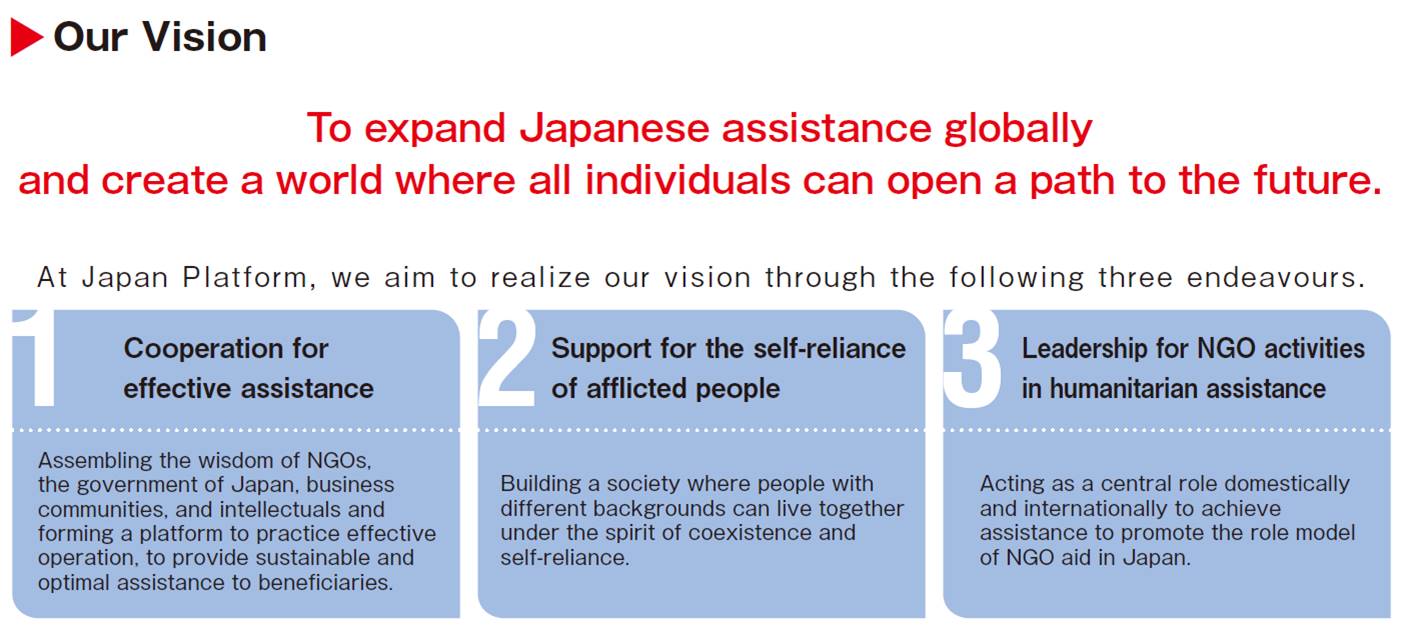
JPF’s Vision
JPF’s Function
JPF’s Structure
Flow of Emergency Response
Fundraising
JPF operates on funding from both the public sector (i.e. the Ministry of Foreign Affairs, or MOFA, of Japan) and the private sector (i.e. donations from corporations, organisations, and individuals). Raising private funds contribute to building the capacity of JPF’s secretariat and supporting the activities of member NGOs. Currently, JPF receives regular support from about 90 corporations and organisations that have become Corporate and Organizational Support Members, as well as from some individual supporters who become Monthly Support Members. Donations, generous gifts of services, know-how from corporations in various industries, and other types of giving have all helped accelerate JPF’s emergency aid activities. Through sharing the contents and results of JPF’s activities and the needs on the ground, JPF has proposed a new relationships between corporations and the NGOs in delivering aid to those in need.
As for public relations, apart from daily base direct communication with media, through events, three websites (Main, English, and Response to the Great East Japan Earthquake), a Facebook page, JPF actively works on media relations and stakeholder relations to raise awareness of the activities of both JPF and its member NGOs. Those strategic contents for public relation are used for promoting fundraising, which has been achieving accountability and raising credibility.
Partnerships
As stated above, JPF is a platform that functions as a partnership among different actors.
Challenges and innovations for the future
Growing the domestic and overseas stakeholder base
JPF has the potential, appeal, and leadership to become the platform that enables the realisation of a civic society that can provide true humanitarian assistance through comprehensively and effectively pulling together the resources of all Japanese aid actors. In order for this platform system to function even better, it is indispensable that more domestic and overseas actors participate in it and create a larger diverse stakeholder base.
Promoting strategic aid delivery
As it has been doing so far, JPF will need to continuously improve the speed and quality of emergency aid delivery in times of disasters, and promote each aid activities based on the solid strategy, where each programme is carried out with a unified policy, objective. The Member NGO could collaborate better under the strategy.
Quick Facts
Population: 126 million
- Year of foundation: 2000
- Staff size: 38
List of members
- Association for Aid and Relief, Japan (AAR)
- ADRA Japan (ADRA)
- BHN Association (BHN)
- CCP Japan (CCP)
- CARE International Japan (CIJ)
- CWS Japan (CWS)
- Radio FMYY (FMYY)
- Good Neighbors Japan (GNJP)
- Habitat for Humanity Japan (HFHJ)
- HOPE International Development Agency(HOPE)
- Humanitarian Medical Assistance (HuMA)
- International Children's Action Network (ICAN)
- IVY (IVY)
- Japan Agency for Development and Emergency (JADE)
- Japan Asian Association and Asian Friendship Society (JAFS)
- Japan Association for Refugees (JAR)
- Japan Center for Conflict Prevention (JCCP)
- Japan Car Sharing Association (JCSA)
- JEN (JEN)
- International Medical Volunteers Japan Heart (JH)
- Japan International Medical TEchnology Foundation (JIMTEF)
- Japan International Support Program (JISP)
- JAPANESE ORGANIZATION FOR INTERNATIONAL COOPERATION IN FAMILY PLANNING (JOICFP)
- Japan Rescue Association (JRA)
- Japanese Red Cross Society (JRCS)
- KnK Japan (KnK)
- Médecins du Monde (MdM)
- Nippon International Cooperation for Community Development (NICCO)
- ONE ASIA (OAJ)
- Operation Blessing Japan (OBJ)
- PARC Interpeoples' Cooperation (PARCIC)
- PEACE BOAT Disaster Relief Volunteer Center (PBV)
- Plan Japan (PLAN)
- Peace Winds Japan (PWJ)
- Reconstruction Assistance Business Expert NETwork (RABENET)
- Save the Children Japan (SCJ)
- Second Harvest Japan (2HJ)
- SEEDS Asia (SEEDS)
- Citizens’ Committee in Japan for Overseas Support (SHAPLA NEER)
- SDGs Promise Japan (SPJ)
- Shanti Volunteer Association (SVA)
- Tono Magokoro Net (TMN)
- World Vision Japan (WVJ)
Private & Public Sector Partners:
- About 90 Japanese corporate partners as Corporate and Organizational Support Members